

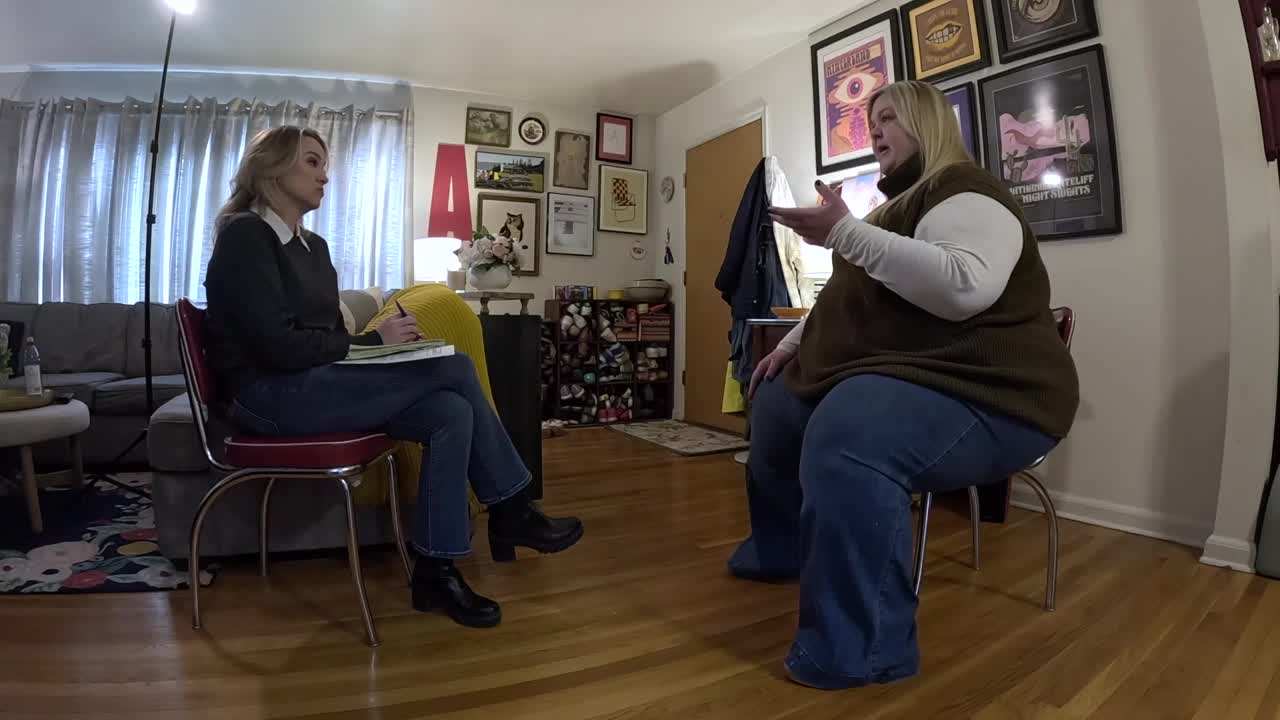


OMAHA, Neb. (KMTV) — Could even one person benefit?
That's what Amy Nissen asked herself as she considered whether to share her own story.
- Two years ago, Nissen experienced an unusually heavy period. After a few months more where she admits she couldn't get it 'under control,' she went to the emergency room.
- Nissen was diagnosed with endometrial cancer, for which she elected to have a hysterectomy. Today, she feels great.
- For Nissen, embarrassment kept her from seeking medical care sooner. She and her surgeon, Lindsey McAlarnen, MD, joined a GSK campaign to help other women.
Continue reading for the broadcast transcript of this story.
Her symptoms started that spring.
"It had gotten to the point where I couldn't go 30 minutes to an hour without needing to go to the restroom. I had had my period for 30 years by this point, and I never experienced something where I couldn't get it under control and I couldn't get ahead of it," Amy Nissen explained.
"I have never taken changes of clothes with me to work and now, I was taking a change of clothes and I was having to change before lunchtime even," she continued.
Imagine having the courage to say that on TV, when Nissen admits she was initially too embarrassed to even see a doctor. Once she did, the diagnosis was endometrial cancer.
"The thing is, talking about it and finding out these things, it could change your life. But it could also save your life," she encouraged.
Lindsey McAlarnen, MD performed Nissen's surgery. They're now both part of a GSK campaign about embarrassment.
"It definitely leads to delayed diagnoses. And I would say, delayed diagnoses in all age groups," McAlarnen said.
Menopausal and post-menopausal women were conventionally linked to endometrial cancer, but McAlarnen is seeing more younger women.
"Talking with patients, there is a relationship between obesity and endometrial cancer. It's driven by estrogen," she began. "And excess weight - fat cells - create excess estrogen."
Nebraska's obesity rate is growing. The most recent state numbers show it's above 35%. And, as explained in the Journal of Clinical Oncology, Nebraska ranks in the upper 90th percentile for deaths related to endometrial cancer.
"I wish I could tell patients: Don't be afraid. Don't be embarrassed. Bring it up to your primary care or OB/GYN provider. We take these things seriously and want to investigate it," McAlarnen insisted.
Because, the bottom line is, an earlier diagnosis means better eventual outcomes.
Nissen is proof.
Today, she feels great and so appreciates having more snapshot moments.
Symptoms can vary based on age - or stage in life, as shown in the chart on the awareness campaign website.
Download our apps today for all of our latest coverage.
Get the latest news and weather delivered straight to your inbox.
