

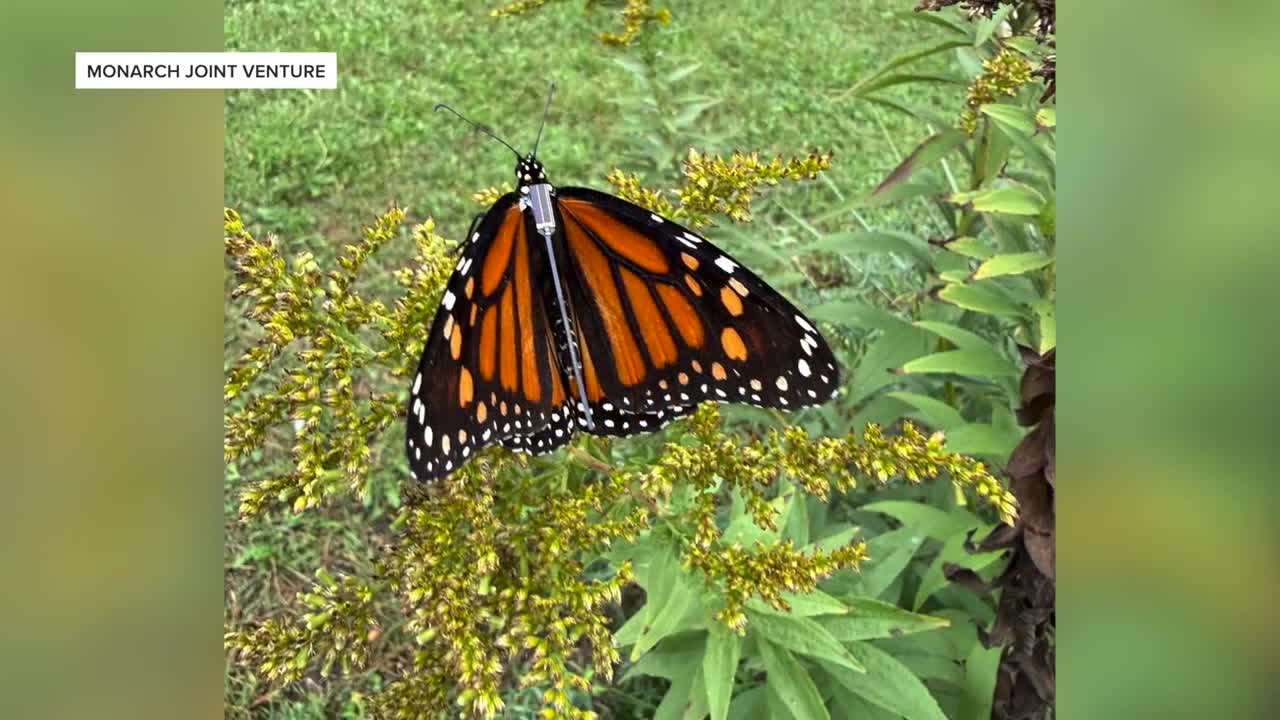


OMAHA, Neb. — New solar-powered tracking technology is giving scientists and the public an unprecedented real-time look at monarch butterfly migration, and you can follow along from your phone.
Mercy Manzanares, project manager at Monarch Joint Venture, has wanted to tag monarch butterflies for years. Now, thanks to new solar technology, that goal has become a reality.
"We're finally being able to see in real time what butterfly migration looks like," Manzanares said.
The organization began tagging monarchs during migration last year. This year, they have successfully tagged 95 butterflies from Nebraska. The solar-powered tracking devices use cell towers to ping the location of each butterfly as it travels south.
Jake Koenig, the Midwest Habitat Program Manager at Monarch Joint Venture, said the data is already revealing new insights.
"We're finding high quality habitats for fall blooming species. We're also finding where they may be roosting," Koenig said.
Monarch butterfly migration is unique in that it is generational. When the butterflies depart Nebraska, the individuals that eventually return will be the great-great-grandchildren of those that left. Scientists believe monarchs navigate using the sun's angle, magnetic fields, and possibly other methods that are not yet fully understood.
"That's part of what we are trying to figure out, those additional details. Certain species use the stars to navigate. Is that playing a factor?" Koenig said.
The free United Monarch app allows anyone to track the migration from home. While some monarchs have not yet left Nebraska, others are already making their way south toward Mexico.
Tracking the butterflies is more important than ever as monarch populations continue to decline across the United States.
"They do us a favor of gathering in one spot every year. We are able to quantify their populations easier than some of the other pollinators," Koenig said.
Monarch Joint Venture plans to continue the tagging program next year, with plans to expand further into western Nebraska.
"It's history in the making," Manzanares said. "Everybody seems to have some sort of connection to monarch butterflies."
This story was reported on-air by a journalist and has been converted to this platform with the assistance of AI. Our editorial team verifies all reporting on all platforms for fairness and accuracy.
