


It's Severe Weather Awareness Week in Nebraska and Iowa. Each day will focus on a specific weather hazard that neighbors in the Heartland deal with on a yearly basis. Today's topic is focused on general knowledge of severe weather. What does the 1 to 5 severe threat scale mean? What's the difference between a watch and a warning? Find out below.
THE SEVERE WEATHER THREAT SCALE
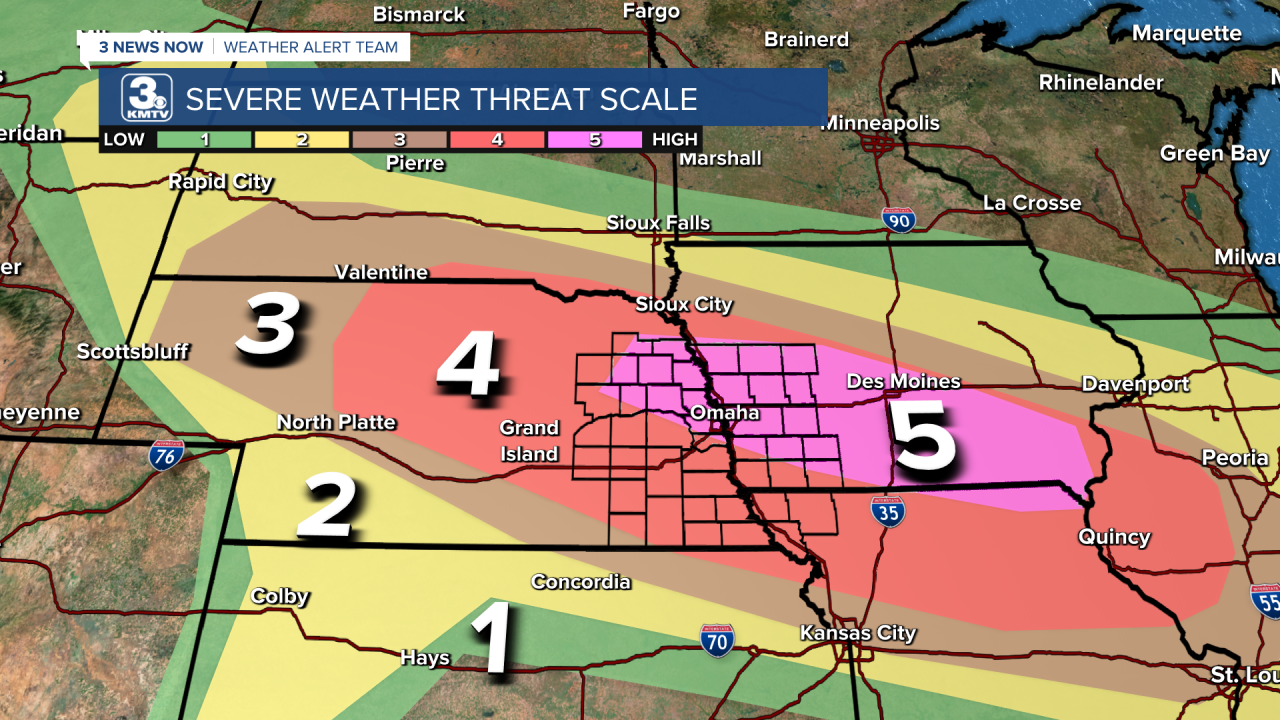
To describe a severe weather threat, a 1 to 5 scale is used to describe the particular risk of severe weather that parts of eastern Nebraska and western Iowa can face on a particular day. In a year, we see about 50 days with a severe weather risk. The 1-5 scale is based on the severity and coverage of the storms.
LEVEL 1 (GREEN) - The lowest risk. While thunderstorms are possible, the overall risk of severe weather is low. These can produce damaging winds, large hail, or an isolated tornado, but they would not be widespread.
LEVEL 2 (YELLOW) - The level 2 risk is the "standard" risk for severe weather. A few thunderstorms are expected to become severe with large hail, damaging winds, and a few tornadoes possible. Of the 50 severe weather risks we see a year, around 35 are level 2 or higher.
LEVEL 3 (ORANGE) - A level 3 risk is when things start to ratchet up. Numerous storms are expected to become severe with large to very large hail, significant damaging winds, and several tornadoes (some strong) possible. Of the 50 severe weather risks we see a year, 3 are level 3 or higher. The Arbor Day Tornado Outbreak of 2024 was at a 3/5 risk.
LEVEL 4 (RED) - A level 4 risk is issued when a significant severe weather or tornado outbreak is expected. A level 4 risk is relatively rare for Nebraska and Iowa, with one being issued every few years. In a level 4 risk, one could expect widespread large hail, damaging winds, and numerous tornadoes, with a few strong tornadoes possible. The last 4/5 risk in our area was the May 21, 2024, "Greenfield tornado" day in southwest Iowa.
LEVEL 5 (PINK) - A level 5 risk is the highest category that denotes a significant to possibly historic severe weather or tornado outbreak. Level 5 risks are rare anywhere in the US. Since 1987, only 21 level 5 risks have been issued for Omaha. The last time we saw a level 5 risk was on June 3, 2014, the day of the Blair hailstorm.
In a watch, conditions are favorable for severe weather, but not imminent. A Severe Thunderstorm Watch means that conditions are favorable for the development of storms capable of producing large hail and damaging winds. Meanwhile, a Tornado Watch means that conditions are favorable for the development of tornadoes. Watches are issued for several hours and span a wide region where conditions are favorable. A watch means pay attention to the weather, but you do not need to take any urgent action.
In a warning, severe weather is occurring or imminent in your neighborhood. A warning lasts for less than an hour until the threat is over. Warnings cover a smaller geographical area, less than the size of a county, depending on the storm.
WAYS TO GET SEVERE WEATHER ALERTS
Have multiple ways to get alerts in case any one of them fails. The more ways you can be alerted to severe weather, the better chance you will get the warning and take action. Here are a few ways to receive alerts:
Weather Radio - You can purchase a weather radio at most stores. These sound an alarm when an alert is issued. You can program them to only sound for specific alerts. Weather radios will alert you to both watches and warnings.
Wireless Emergency Alerts (WEA) - Most phones have this feature pre-installed. This is the same system for Amber Alerts. Wireless Emergency Alerts will only sound in a Tornado Warning or a Severe Thunderstorm Warning where the hazards are baseball-size hail and/or 80+ mph winds. Although your phone automatically has them enabled, check the WEA settings to make sure they are still turned on.
Television - At the bottom of KMTV's screen is a crawl that displays any watches and warnings that are in effect. This should be a secondary way to get alerts, as the TV needs to be on.
Phone Apps - Hundreds of phone apps will alert you when dangerous weather approaches, some more reliable than others.
Outdoor Warning Sirens - While useful, outdoor warning sirens should never be your only way to get alerts, as they are meant for outdoor use. Even if you can hear them inside, the chances of hearing them in the middle of the night during a raging thunderstorm are lower. Thus, have multiple ways to receive alerts!
