

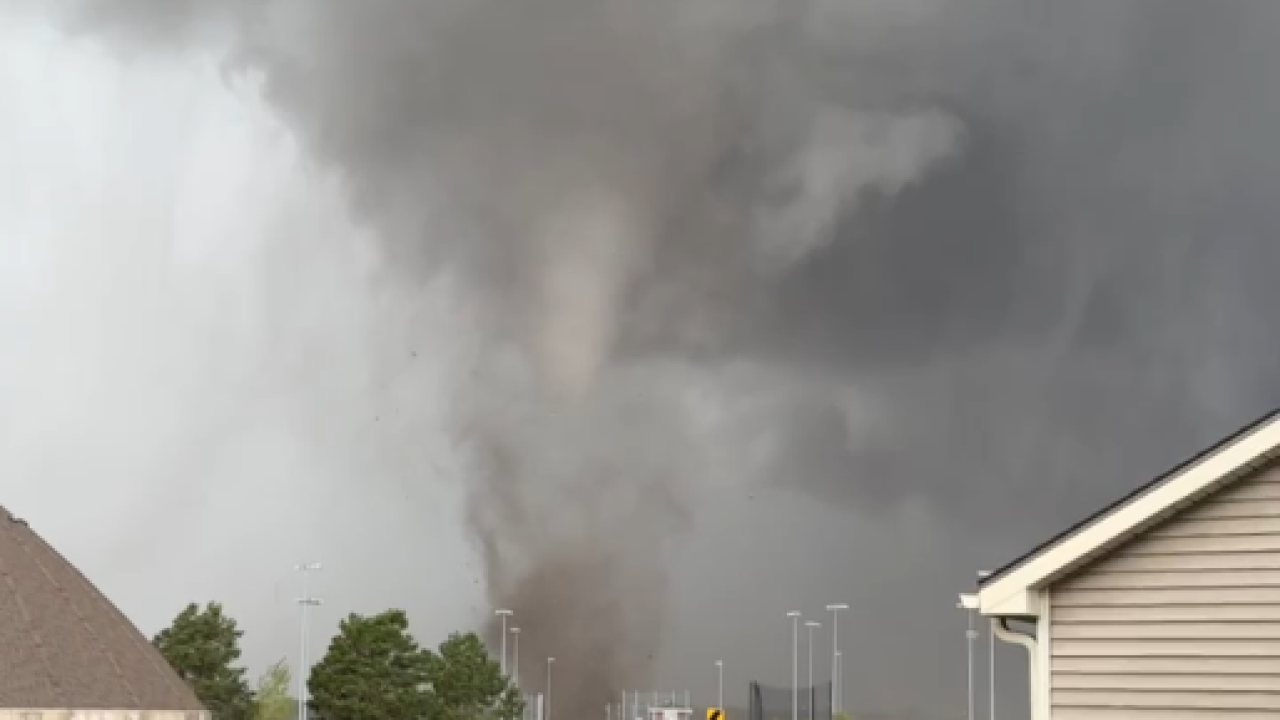


It's Severe Weather Awareness Week in Nebraska and Iowa. Each day will focus on a specific weather hazard that neighbors in the Heartland deal with on a yearly basis. Today's topic is one that many longtime residents of Nebraska and Iowa will be familiar with: tornadoes. Learn how they form, how they are rated, and how to keep safe below.
HOW A TORNADO FORMS
Recall how a thunderstorm forms. There is an updraft, a column of warm rising air, and a downdraft, the rain/hail shaft. The ingredient that turns these ordinary thunderstorms into tornadic thunderstorms is wind shear. Wind shear is the change of the wind with height, either in speed or direction. For a tornado, you need both speed shear and directional shear. Speed shear helps to tilt the storm so the rain falls away from the updraft, and directional shear causes the storm to rotate.
The mesocyclone, a rotating updraft, will then ingest columns of rotating air near the ground, which becomes tilted. Once this rotating column of air spins fast enough, it dips to the ground and causes damage; now you have a tornado.
TORNADO SAFETY
If a tornado warning is issued, there are many things to keep you and your family safe. The main thing is not to panic, despite their destruction, tornadoes are survivable (even EF-5s) if you take the precautions to protect yourself. The number 1 thing to do is get underground, whether a basement or a storm shelter.
If you do not have a basement, you can go to the lowest floor of a sturdy building and find an interior room. This can be a hallway, closet, or bathroom. Basically, put as many walls between you and the outdoors as possible. If you do either of those two things, your chance of surviving a tornado, no matter the strength, is quite high.
Under any circumstances, should you be in a mobile home during a tornado, even in weak tornadoes, mobile homes can be tossed or destroyed. If you live in a mobile home, during a tornado warning, leave and find a more sturdy shelter. If you are in a car, pull over and find the nearest sturdy structure to shelter in. If you can not do that, an absolute last resort is to lie in your car or find a ditch.
TORNADO FACTS AND MYTHS
Nebraska and Iowa are part of "Tornado Alley". On average, about 45 tornadoes occur in both states. Peak tornado season runs from March to July, with May and June being the most active months. However, as we saw in December 2021, tornadoes can occur any time of year if the conditions are right.
Many tornado myths persist, even after being debunked. Some of these myths include tornadoes not impacting downtown areas, crossing waterways, or not traveling over hills. These are all false; tornadoes can travel over any terrain.
THE ENHANCED FUJITA SCALE
Tornadoes are rated by the Enhanced Fujita Scale (EF-scale for short). The Fujita scale was devised by legendary tornado researcher Ted Fujita (for more information on his life and work, click here). In 2007, his original scale was revised to account for more damage. The Fujita scale is based on damage and is used to estimate the wind speed. Here is a relative breakdown of the scale:
EF-0 (65-85 mph) - "Light" Damage - This is the weakest of the categories. EF-0 tornadoes are responsible for minor damage. Examples of damage include: snapped tree branches or small trees, shingles peeled off, sheds/grain bins with significant damage, irrigation pivots overturned, power poles bent, and windows broken from buildings.
EF-1 (86-110 mph) - "Moderate" Damage - EF-1 tornadoes start to do some more significant damage. Examples of damage include: garage doors being blown in, siding torn off homes, mobile homes flipped or moved, trees and power poles snapped, cars flipped, and minor roof damage to homes.
EF-2 (111-135 mph) - "Considerable" Damage - Any tornado with a rating of EF-2 or higher is classified as a "strong tornado" as the damage it can cause becomes more extreme. Examples of damage include: roofs removed from homes, barns destroyed, cars flipped and moved, mobile homes destroyed, and major tree damage.
EF-3 (136-165 mph) - "Severe" Damage - In an EF-3 tornado, damage becomes more widespread and severe. Examples of damage include: exterior walls of homes collapsing, two-story homes losing their second floor, trees being uprooted, metal buildings sustaining heavy damage, cars being thrown far from where they originally were, and larger vehicles such as tractors being lifted. The tornado along the Douglas-Washington County line in April 2025 was an EF-3, as was the tornado that struck Minden on April 26, 2024.
EF-4 (166-200 mph) - "Extreme" Damage - An EF-4 tornado is rare and is classified as a "violent tornado", and only occurs a handful of times per year in the United States. Examples of damage include: trees debarked, cars mangled, well-constructed homes leveled, masonry buildings suffering heavy damage, and smaller structures completely wiped away. EF-4 tornadoes in Nebraska include the Elkhorn-Blair tornado on April 26, 2024, and the Stanton/Pilger/Wakefield tornadoes of June 16, 2014. The last EF-4 tornado in Iowa was the Greenfield tornado on May 21, 2024.
EF-5 (201+ mph) "Massive" Damage - The EF-5 is the rarest and most violent tornado category. Since 1950, only 68 tornadoes have been classified as (E)F-5 in the United States. The last F-5 tornado in Nebraska was on May 5, 1964, which impacted the area from Hastings to Osceola. The last EF-5 in Iowa was the Parkersburg tornado on May 25, 2008. Examples of damage include: frame homes being swept clean from their foundations, steel-reinforced concrete buildings being heavily damaged, trees being completely debarked and snapped, cars being tossed hundreds of yards away, and the ground being scoured.
