

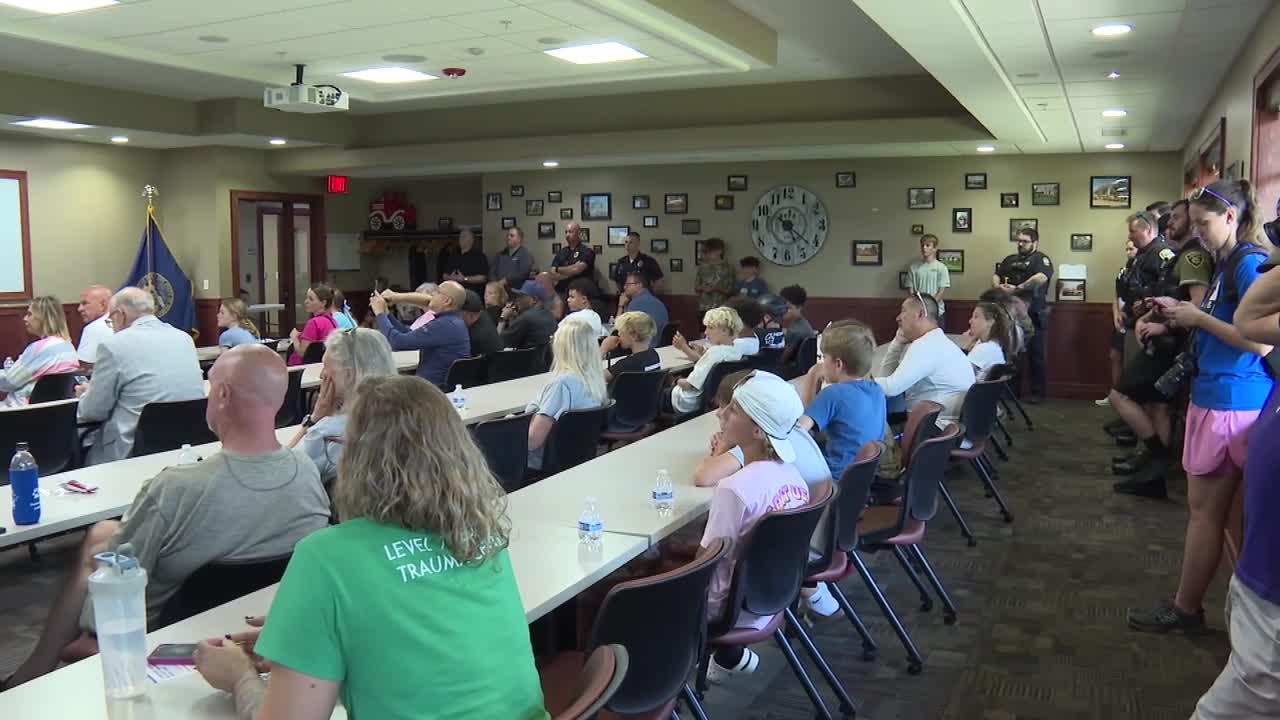


BENNINGTON, NE. — Residents packed the Bennington Fire Department Monday evening to learn about the safety and legal details of e-vehicles, following several accidents in and around Bennington involving e-scooters, bikes and golf carts over the past 30 days.
"The unfortunate events that happened in Bennington over the last thirty days are what's bringing us here," said Brian Ortner, an AAA specialist who spoke at the event.
Ortner explained the distinctions between different types of electric vehicles.
"One of the simplest definitions of an e-bike and an e-moto (is) pedals," Ortner said. "E-bikes are pedal-driven with electric assist. An e-moto (has) no pedals, (is) fully electric and (can be) going over 28 miles per hour."
Residents used the meeting to ask questions directly relevant to their community, including concerns about young children operating the vehicles.
"Can a six-year-old kid be riding on a scooter in the road, doing 20 to 25 miles an hour?" a Bennington neighbor said.
Douglas County Sheriff Aaron Hanson addressed the question, warning that parents could face legal consequences if their children continue to appear before the juvenile county attorney on related cases.
"What the juvenile county attorney is set to do is if those same kids continue to be in front of them on these cases, they will go after the parents, eventually, for a 3A action --- it means the parents aren't adequately supervising their kids," Hanson said.
The event comes as local agencies say they are fighting reckless driving both in Bennington and across the metro.
The Douglas County Sheriff's Office shared video with KMTV showing what they say is a teenager driving an illegal dirt bike down the middle of the road near 192nd and Harrison.
Event organizers say state and local laws regulating e-scooter, e-bike and e-moto safety have not kept up with usage and technology — something they are aiming to lobby lawmakers to change.
Julie Harris, executive director of Bike Walk Nebraska, said policy changes are expected to move forward this fall.
"I think state-level policy will likely end up with better definitions in the state's statutes about what different types of these devices are," Harris said. "We will have state-level recommendations this fall."
