


WALTHILL, Neb. (KMTV) — More than a century after Dr. Susan La Flesche Picotte broke barriers in medicine, a new Barbie is introducing her story to another generation.
Dr. La Flesche Picotte, a member of the Omaha Tribe, became the first Native American in the United States to earn a medical degree. She later opened a hospital in private Walthill, where the historic building still stands today.
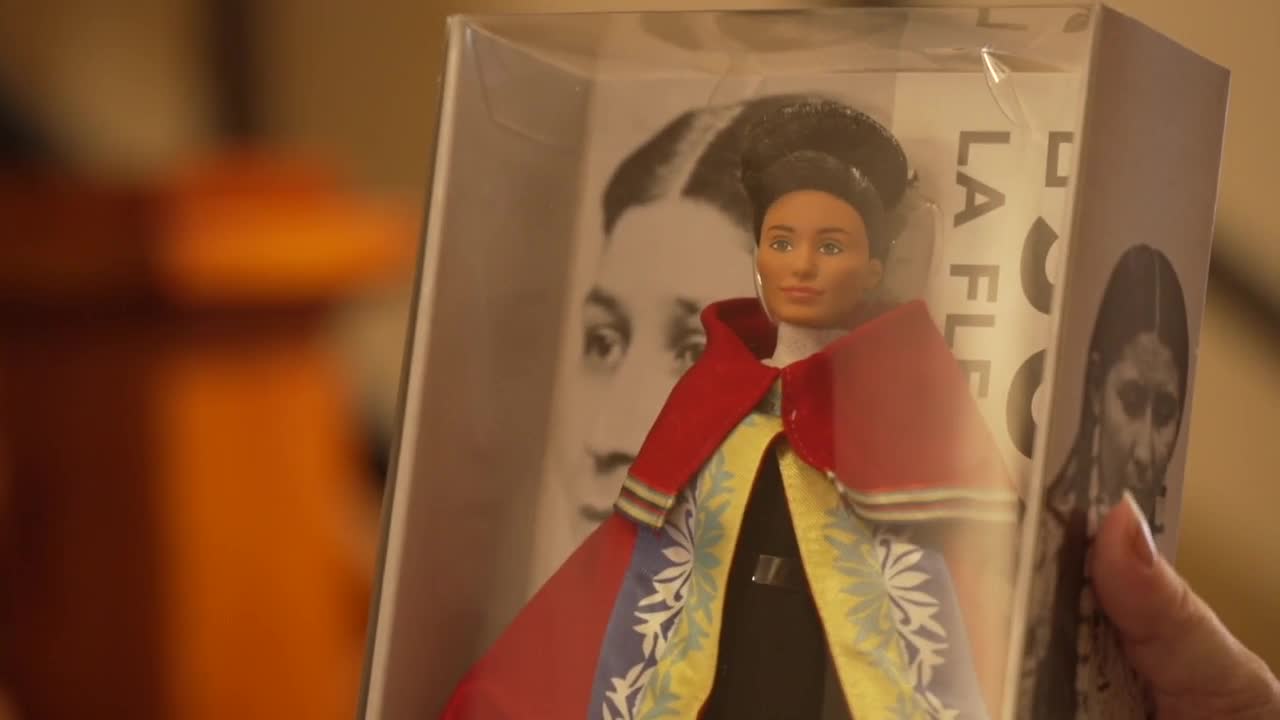
Now, Dr. La Flesche Picotte has been honored with a Barbie doll modeled after her.
For Liz Lovejoy Brown, a member of the Omaha Tribe and executive director of the Dr. Susan La Flesche Picotte Center, the doll represents something she did not have growing up.
“It was so hard to find a toy that looked like you if you were a minority,” Lovejoy Brown said.
Raised in Omaha, Lovejoy Brown said she first learned about Dr. La Flesche Picotte through her family.
“My mom told me about Dr. Susan when I was a little girl,” she said.
That story eventually helped inspire Lovejoy Brown to follow a similar path.
“I said, you know what, I’m going to do the same exact thing,” she said. “I’m going to go back, I’m going to get my education and help my people.”
Lovejoy Brown's position at the historic hospital gave her the opportunity to work with Omaha Tribe members, a descendant of La Flesche Picotte and Mattel during development of the Barbie.
She said the process took about two years, with close attention paid to portraying La Flesche Picotte accurately.
“First, she had the right facial features,” Lovejoy Brown said. “We really wanted to capture the high cheekbones, her eyes, her nose.”
One of her favorite details is the doll’s honor blanket.
“What I really loved was the honor blanket, which really captures our culture,” she said.
For Lovejoy Brown, La Flesche Picotte’s life is also an example of maintaining a connection to Native culture while navigating a predominantly Western society. The honor blanket over her dress is the perfect showcase of that juxtaposition in her mind.
“Either you’re absorbed in Western society or you're very involved in your culture, and you have to try to find that balance,” she said. “And she found that balance.”
Tracey Herre traveled from Fremont with her Dr. La Flesche Picotte Barbie to see the historic hospital.
Herre, who has Cherokee roots, purchased one of the 10,000 dolls produced.
“It’s very exciting to be able to come and see where she practiced and the old building,” Herre said. “It’s really perfect.”
Lovejoy Brown said the Barbie has also captured the attention of younger generations, including her daughter, who put the doll at the top of her birthday list.
She has watched videos online of children opening the doll and hopes Dr. La Flesche Picotte’s story shows them what is possible.
“They have that ability to go after their dreams because if you look at what Dr. Susan went through, you can do that too,” Lovejoy Brown said. “You can go beyond that.”
Lovejoy Brown believes Dr. La Flesche Picotte, if she were alive today, would still be looking for ways to address the problems facing her community.
That idea continues to shape the work at the historic hospital.
The center grows a vegetable garden, partners with the University of Nebraska Medical Center to provide health care options and works with the local Boys & Girls Club.
 Facebook
 YouTube
 Instagram
 X
This story was initially reported by a journalist and has been converted to this platform with the assistance of AI. Our editorial team verifies all reporting on all platforms for fairness and accuracy.
